50 shades of black music (2013)
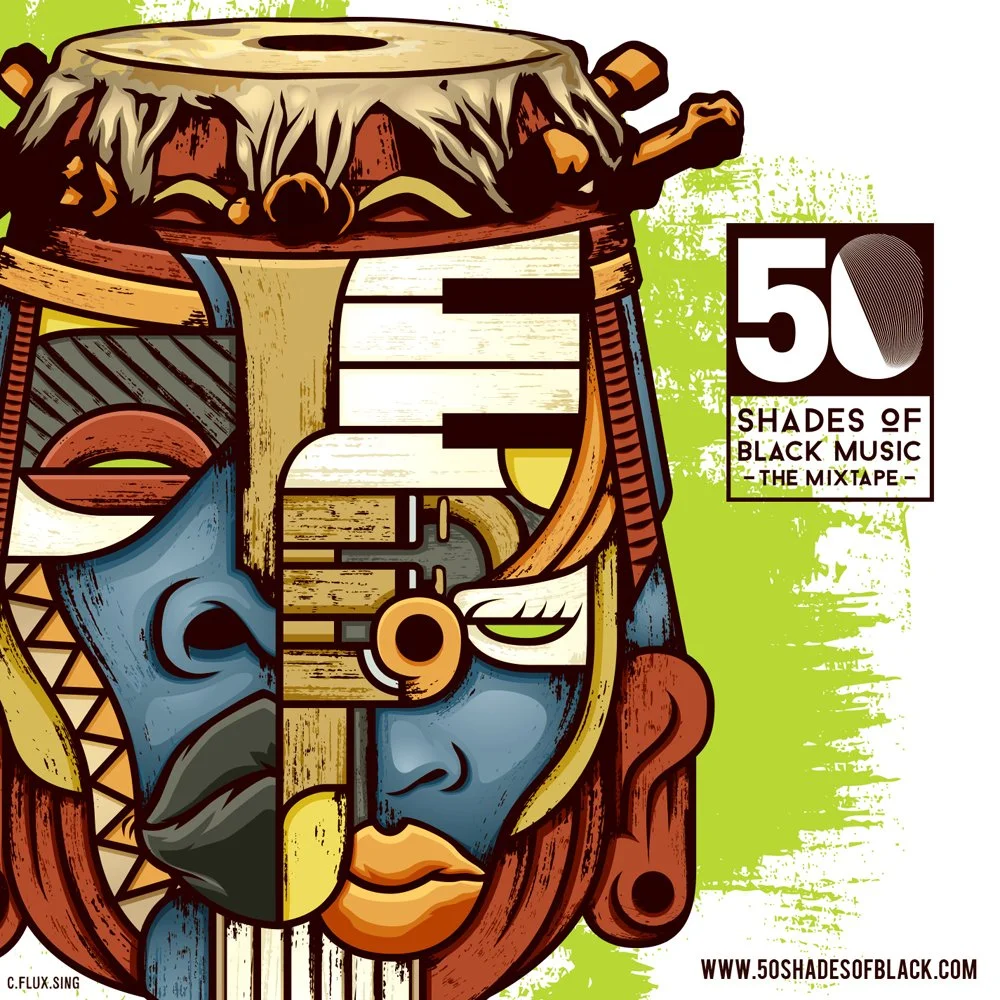
Click on cover to listen
Carlton and I sat outside a coffee shop on one of the days Atlanta decided to have good weather, drinking Earl Grey to indulge my British roots. One of us said "there should be a 50 Shades of Black Mixtape." Then there was one of those moments where an idea starts to germinate in your head so quickly that it is represented in your face - by eye squints and furrowed brows of concentration and chin rubs and hands drawing shapes in space. Or in Carlton's case by running around the coffee shop shouting "OH SNAP!"
And so a mixtape was born.
The mixtape itself is two 50 minute sets (a side A and side B, if you will) that roughly follows a historical timeline. I tried to let the music speak for itself and left any manipulation subtle. I was guided by genre and then selected key songs or pioneers from within those genres, starting with the work songs of enslavement and ending with then contemporary representations in hip hop.
As with any retrospective, some tough choices had to be made for time and fit, so the absence of a particular artist is not a slight or an oversight (it was a rough afternoon when I decided I had to cut Billie Holiday and John Coltrane). Also, with the decision to emphasize diversity of genre, the result is a(n unfortunate) sacrifice of diversity in other areas such as gender. Where it was possible I opted for variety, but with each genre explored, the pioneering voices were predominantly male and predominantly heterosexual which speaks to larger issues of the nature of access in music more so than it does about tracklisting decisions.
In making those tough decisions, I wanted the mixtape to accomplish three things. Firstly, I wanted it to be a showcase of the history and diversity of 'Black Music' in America, highlighting all the forms and styles that have stemmed from black experiences, including some of the international influences. In this regard Dr. Portia Maultsby's "A History of African American Music" which traces the development of African-American musical styles was particularly useful. Secondly, much in the tradition of the medium, I envisioned the mixtape as a gift, from older generations to new, between friends, from parents to children, particularly for Carlton's son, Isaiah, whose voice is heard throughout the mix.
I used to sit in the living room, headphones on my head, digging through my father's vinyl albums as a kid, learning about older music, seeing where modern music got its influences and it is my hope that the listener understands my intent and shares widely. Lastly, I wanted this to represent an intersection between hip hop tradition and scholarship, an academic mixtape, where you could both nod your head and feed your mind, might I say, at the same damn time.
50 SHADES OF BLACK MUSIC - THE MIXTAPE (2013)
Enjoy it. Critique it. Share it.
……
Artwork created by Atlanta based artist C. Flux Sing.